What Are AI Agents, Really?
AI Agents are software entities powered by artificial intelligence that perform multi-step tasks on behalf of humans - often without constant input or supervision.
Unlike simple automations or chatbots, true AI Agents:
- Can understand intent, make decisions, and take actions
- Operate across systems, tools, and workflows
- Learn and adapt over time for better outcomes
Think of them as digital coworkers. They don’t just respond - they execute.
Where things are going:
Deloitte’s latest State of Generative AI in the Enterprise survey (January, 2025) indicates that AI agents and industry-specific model customization are emerging as leading strategies for businesses to achieve meaningful ROI from generative AI.
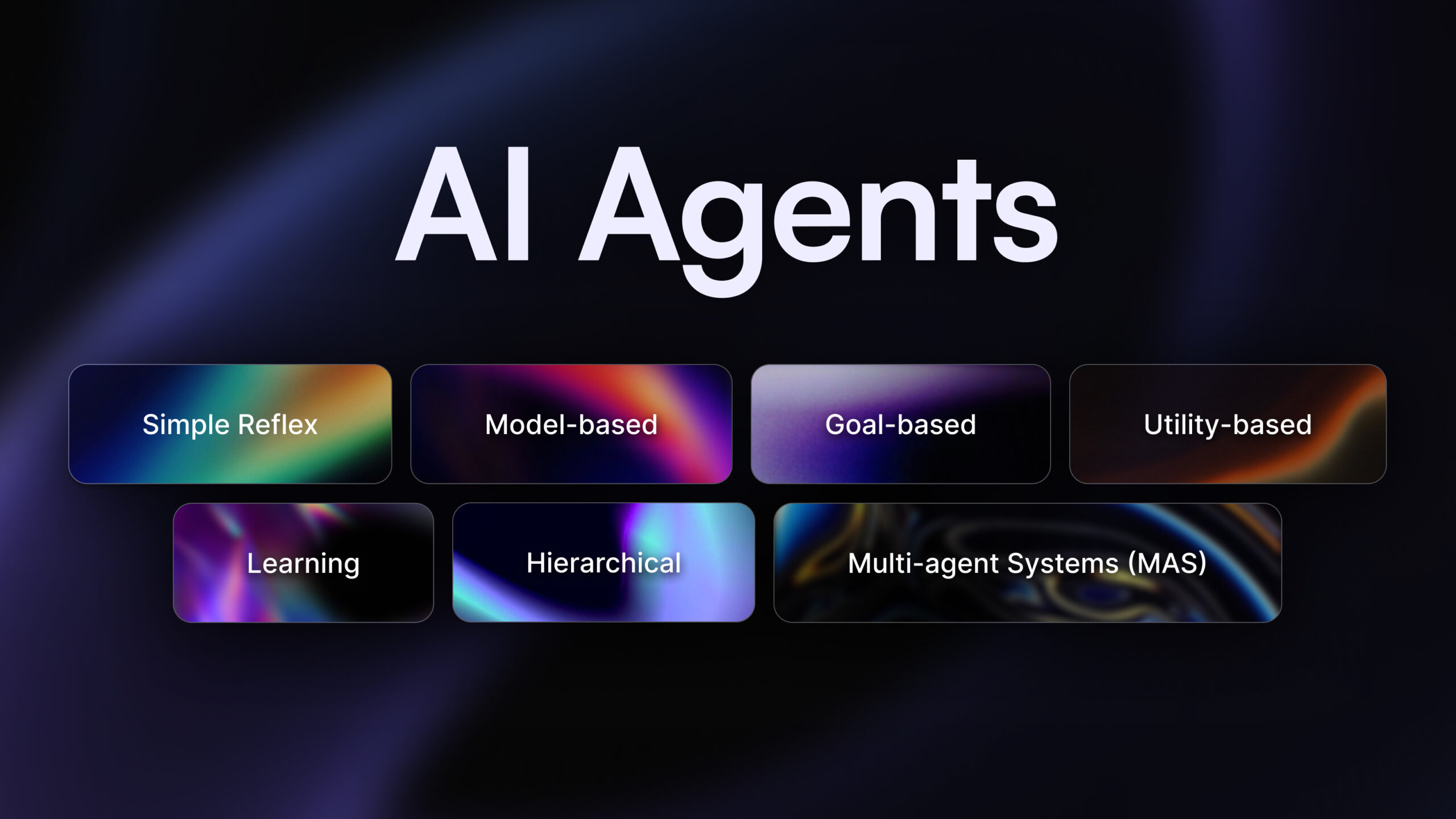
The 7 Types of AI Agents
According to CyberIntelligence (2025), AI agents fall into 7 distinct categories:
1. Business-Task Agents
- What they do: Automate repetitive business tasks across systems
- Examples: Invoice processing, data entry, scheduling
- Tech: Microsoft Power Automate, Zapier + AI, UiPath
2. Conversational Agents
- What they do: Handle voice or text conversations for support
- Use Cases: HR chatbots, IT helpdesk, customer service
- Examples: Google Dialogflow, Salesforce Einstein
3. Research Agents
- What they do: Retrieve and analyze data from trusted sources
- Use Cases: Academic citations, market analysis, technical Q&A
- Examples: OpenAI Deep Research, Perplexity Pro
4. Analytics Agents
- What they do: Generate charts, reports, and business insights
- Use Cases: Dashboard creation, business intelligence
- Examples: Power BI Copilot, Glean
5. Developer Agents
- What they do: Write/debug code with minimal oversight
- Use Cases: Code completion, debugging, refactoring
- Examples: GitHub Copilot, Cursor
6. Domain-Specific Agents
- What they do: Built for complex industries (finance, legal, healthcare)
- Use Cases: Medical triage, contract analysis
- Examples: Harvey (legal), Hippocratic AI (healthcare)
7. Browser-Using Agents
- What they do: Mimic humans on web apps (click buttons, fill forms)
- Use Cases: Web ordering, form submission, CRM updates
- Examples: OpenAI Operator, Google Project Tailwind
Why Does This Matter?
Here’s the catch: not every AI agent is right for your business.
Choosing the wrong kind (or vendor) can lead to:
- Wasted budget on features you don’t need
- Disconnected tools with no ROI
- Long implementation times with no clear outcome
The gold nugget is in matching the right agent type to your real business problem - not jumping on trendy tools.
For example:
- If your operations team spends hours on manual order entry → you likely need a Business-Task Agent
- If your salespeople are hunting through SharePoint to prep reports → a Research Agent or Analytics Agent fits best
- If your legal team drowns in contracts → a Domain-Specific Agent will deliver the most impact
Knowing what type of AI agent to implement is the difference between AI that saves hours — and AI that adds headaches.
Where SupaHuman Fits: Built-for-Purpose Intelligence
We don’t just install tools - we craft fit-for-purpose AI agents that match your real workflows.
Here’s where SupaHuman's client work fits:
Business-Task Agents
Clients: House Of Travel, Mariners Log Engineering, SkyCity, Gold Club Tours, NZME, JaniKing, D3 + more
Examples: AI agents that automate scheduling, form entry, invoice handling
See JaniKing case study here
Conversational Agents
Clients: Fonterra, Business Mentors, CACI, ThroughLine
Examples: Franchise Support AI, Mentor AI Copilot, AI Agent Safeguarding
See Transcends case study here
Domain-Specific Agents
Clients: MAST Academy, Skills4Work, Impact Chain, Competenz, Tadpole, Clinical Trial + more
Examples: Assessment & study material creation, Legal triage bots, compliance review, healthcare admin AI
See MAST Academy case study here
Research Agents
Clients: AI Forum NZ
Example: Live White Paper, Complex Mega Doc
Analytics Agents
Clients: Cardinal
Example: Warehouse Management AI
Conclusion: AI Isn’t One Size Fits All - And Neither Are We
The AI landscape is noisy - and fast. But with the right AI agent (matched to your business’s actual needs), you can unlock real productivity gains and strategic edge.
At SupaHuman, we help you cut through the clutter by:
- Identifying what kind of agent your business actually needs
- Building a custom solution that integrates seamlessly with your tools
- Supporting adoption so your team wins from day one
👉 Whether you’re curious where to start or ready to scale - we’re here to help you find your fit.

.png)